
From an entrepreneur’s motorbike to 60,000-square-foot facility: Spaldings’ longstanding customer relationships remain the heart of its brand
Just over 60 years ago, a group of Lincolnshire farmers identified a need for aftermarket spare parts and, when the opportunity arose, they purchased a business from Albert Spalding who sold brushes and shovels on the back of his motorbike. Fast forward to today, the once-small enterprise has developed into Spaldings, a ‘one-stop farm shop,’ as described by CEO, Paul Bray. Operating from a 60,000-square-foot warehouse in Lincoln, Spaldings is the UK’s largest distributor of agricultural aftermarket parts and employs 42 field sales reps across the UK and Ireland. Paul tells Manufacturing Today more about its 2025 acquisition by Invicta Holdings.
“Invicta’s portfolio of businesses are aftermarket spare parts companies across agriculture, construction, and automotive,” begins Paul. “Naturally, when Spaldings was put on the market, it was a perfect fit. I’ve been at the company for 25 years and it’s very much a meritocracy. Most managers or directors started off in their own department and worked their way through, which is unusual.” After leaving Spaldings for three years to work for a competitor, Paul returned with the vision of restoring the deep-seated company culture. “It’s very rare to have salesmen who have been with a company for 25 to 30 years,” he continues. “Our longest-serving employee completed 50 years in December last year.”
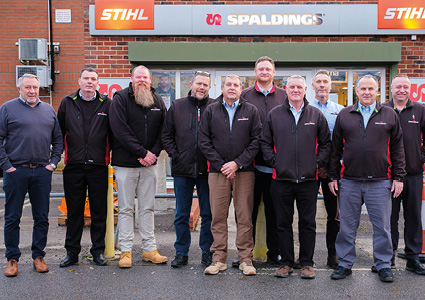
Due to high levels of employee retention, the company culture provides a family environment. “People join the company and they love working here so much they don’t want to leave. It becomes a way of life,” Paul explains. “Even though sales employees earn commission, all our employees are on a bonus scheme. When we attain targets, everybody is rewarded – the sales team, office-based staff, warehouse operatives and packers. They’re all working extremely hard to ensure our customers are happy, so they need to be rewarded. It creates a nice team ethic.”
Building client relationships
Although it now operates a fully functional e-commerce website, Spaldings’ large network of dedicated salespeople is one of its main strengths. “They have very strong relationships with customers,” states Paul. “We want our sales team to feel like an extension of our customers’ business. They know the machinery, they’re incredibly knowledgeable and they can recommend products.” Its agricultural division has 32 representatives, and the groundcare division employs ten, with both teams operating differently. “If one of our agricultural reps goes to a farm, it’s likely they will walk away with an order. Alternatively, when dealing with a local authority, we need a purchase order to be approved, so we must tender to be on quite a few frameworks,” Paul explains.
During the acquisition period, multiple suitors proposed digital transformation. “We had several businesses interested in Spaldings but many were predominantly looking at how they could monetize it and become a solely digital, online business,” Paul shares, “However, this absolutely would not work with our business. We very much pride ourselves on our face-to-face relationships with customers and we’re dealing with a generational customer base. Spaldings has built its reputation on quality, service and value for money. Your customers become your friends – it’s a way of life. You’re travelling around the countryside visiting either stately homes or muddy farms.”
With client relationships at the forefront of the business, product development follows essential customer feedback. “All our product development is customer-led,” notes Paul. “All feedback, comments and opinions are entered onto a portal, and we then have a monthly product meeting to decipher whether suggestions and ideas are viable; Can we stock and distribute it? Can we be competitive? Can we make money from it? These are the important questions.”
The company’s engineering capabilities extend beyond sourcing as Spaldings also redesigns retired OEM parts. “If a customer has identified a particular problem, we can engineer it with our software and technology, before applying it into a 3D printer and testing whether it fits prior to producing samples, ultimately saving time and money.” Investment in such technology has been focused on operations. Not only has the company invested heavily in scanners and 3D printers, but it also installed a barcoded warehouse management system about three years ago, which has dramatically reduced picking errors and made stock take more efficient.
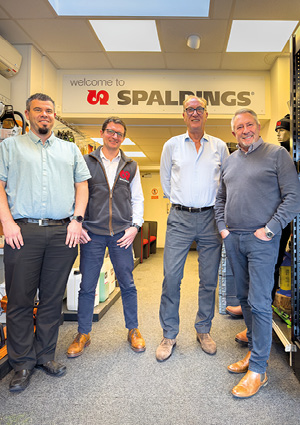
Driven by ongoing economic pressures, Spaldings is constantly looking at product development and innovation. “The agricultural industry is changing massively,” Paul says. “With the changes to farm subsidies and inheritance tax, it’s a tough climate for farmers, so we’ve been looking at other ways to mitigate that risk.”
Three new ranges have already been launched for 2026, including a crop nutrient product called Bionature, creating stronger plants and more yield. “As this is our first time exploring the crop nutrient sector, we’ve invested in hiring experienced people, and one of our new employees is highly qualified to advise farmers. We’ve taken a step outside of our comfort zone, but it’s exciting and we’re hoping it’s going to be a success.”
The acquisition by Invicta also means taking advantage of global product access, including a full range of power take-off (PTO) equipment, while its third range targets recycling. “Farmers have diversified and local authorities are processing green waste and wood waste. We’re bringing in parts to suit recycling machinery, which we hope to launch within the next two to three months,” adds Paul. Alongside the endorsement of recycling, Spaldings’ environmental initiatives center on its vehicle fleet, as it switches from traditional vehicles toward electric and hybrid. Additionally, procurement maintains UK focus with almost 70 percent of its products obtained domestically.
As our conversation closes, Paul shares more about Spaldings’ five-year vision to preserve market leadership whilst expanding scope. “Back in the 1960s when the farmers bought the business, they wanted to cut out the dealerships and go straight to manufacturers, buy the parts, and sell them directly to the end user,” says Paul. “Today, we’re the largest of our type in the UK selling directly to the end user, and I see that continuing to grow. We also want to move significantly into recycling. Ultimately, you can get everything you need for your farm from our catalogue. We’re like an Amazon for farmers.”
Since the days of entrepreneur Albert Spalding selling equipment from his motorcycle, Spaldings has continued to demonstrate that customer familiarity creates durable competitive advantage. The company that ambitious farmers bought in the 1960s to cut out dealerships now employs 42 field sales reps with 25-to-30-year tenures, operates from a 60,000-square-foot facility and deliberately refused digital transformation when choosing Invicta as an investor. As Paul navigates farm subsidy elimination and inheritance tax changes through crop nutrient innovations, PTO equipment and recycling machinery parts, one conviction remains for the face-to-face relationship business: ‘your customers become your friends.’