
How Tropic Skincare’s natural ingredients, community commerce and charity work are reshaping ethical beauty
In 2003, 15-year-old Susie Ma set up a market stall beside her mother in South London, armed with little more than her grandmother’s homemade body scrub recipe and a determination to fund rent and education after moving from Australia to the UK. More than two decades later, Susie’s entrepreneurial spirit and passion for natural, ethical ingredients drives one of the UK’s fastest-growing beauty brands – Tropic Skincare (Tropic). Since its founding, Tropic has built a community of thousands of ambassadors, opened schools on four continents, and proven that ethical business and commercial success are not a trade-off, but a harmonious partnership.
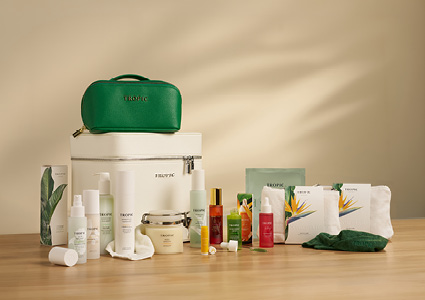
With ranges spanning skincare, haircare, bodycare, makeup, sun care and tanning, the beauty brand has grown monumentally over the past 23 years and has become a science-backed, data-driven business while remaining completely organic, vegan and cruelty-free. Managing Director, Carlton Connell, joined Tropic when the business launched its ambassador program 14 years ago, and joins us today to share more about the company’s recent investment in manufacturing and facilities, its inspirational charity work, and growth ambitions for 2026 and beyond.
“Susie’s mother and grandmother were dedicated to natural living, so this has been in our DNA since inception,” Carlton begins. “We simply believe there is a better way than using synthetic ingredients and we’ve invested heavily in proving it. By working closely with our suppliers to find organic alternatives to conventional ingredients, we’ve been able to ensure our products not only feel amazing, but they deliver real, clinically proven results.” An example of this is retinol – a derivative of Vitamin A – which is hugely popular in the beauty industry today. “We use a plant-derived retinal, sourced from sea algae. It performs the same way but stays true to our values.”
Tropic holds multiple key accreditations including Cruelty Free International, Vegan Society and Cosmos certification, assuring customers that none of its ingredients are tested on animals nor animal derived. “We also work with Provenance, which traces the full lifecycle of our ingredients right back to the source,” Carlton continues. “Using a product’s batch code, you can track an ingredient all the way to the farmer who grew it – showing that they are fairly paid, the farming practices are certified organic and that everything we claim on-pack is independently verified. There is a meaningful difference between saying you use organic ingredients and having that claim certified by an external body.”
Carlton describes Tropic’s business strategy as ‘community commerce’ and favors this model over more traditional direct sales, due to its alignment with the company’s ethos. “In many ways, the model is an extension of how Susie started on the market stall – demonstrating products and allowing the public to experience them firsthand,” he notes. “We have over 20,000 Tropic Ambassadors who visit people’s homes, let them try the products and really experience the brand. Today, 95 percent of our business is sold through this incredible community of Ambassadors across the country.” Authenticity is what makes this approach so powerful. While television advertising, social media and affiliation are all effective marketing channels, Tropic focuses on valuable in-person connections with real people who genuinely love the product they’re selling and thrive on building a community.
As it continues to expand, the brand is preparing its facilities. “We want to grow and create more impact globally,” Carlton highlights. “We’ve made a major investment in scaling up and organizing for international production. What’s critical to us is keeping everything under one roof – manufacturing, production, dispatch, warehousing and marketing. That level of control enables both high quality and speed. If a new ingredient comes to market that we love, we don’t have to navigate external contract manufacturers and lengthy timelines. We work with Susie and our formulation team, scale up in our own factory, and can have a new product ready within a month.” Alongside the factory itself, Tropic is upgrading its HQ facilities for a 250-strong team. “We invite Ambassadors to our premises monthly, so they can meet the team, learn how to make products and connect with the people behind what they’re selling,” explains Carlton. “We want that space to reflect the brand and to be somewhere our staff are truly proud of.”

A remarkable ten percent of Tropic’s profits are donated to global charities, including a South African orphanage for children who have lost parents or grandparents to AIDS, and a significant portion of the company’s contribution is given to United World Schools (UWS), whose mission is to end education poverty. “Education has always been deeply personal to Susie,” Carlton reflects. “Despite all the hardships she faced, her own education is what propelled her to the position she is in today. She has always believed that every child in the world should have access to education – not necessarily to change the world, but to have the freedom of choice.” Tropic has worked with UWS since 2019 across Madagascar, Myanmar, Cambodia and Nepal. The charity works in partnership with governments and local communities from the outset, with the goal of running each school for four to five years before handing it back to the government – then the funding can move on to new communities. Carlton reveals: “In Nepal, when UWS first began working in the five communities we support, fewer than 50 percent of children had access to education. That figure is now over 96 percent. It’s wonderful.”
With over 23 exciting new products launching across 2026, and up to 14 festive gift sets launching in time for the all-important final quarter, Tropic shows no signs of slowing down. For Carlton, growth has always been rooted in something deeper. “If we demonstrate that a business like ours can still donate ten percent of profits to charity, then hopefully larger organizations will follow,” he says. “We don’t want to do it alone!”
International expansion is on the horizon too, with Tropic’s unwavering ambition to carry its signature blend of community, conscience and clinical-grade natural beauty to customers around the world. “Ultimately, our aim is to be operating globally, doing exactly what we do here in the UK and maintaining full control of everything we produce,” ends Carlton. “We want to spread the Tropic ethos around the world and create even more impact as we go.”