
In this Q&A from Giampaolo Marino, he discusses moving to a more connected physical environment
E-commerce has long had a data advantage over physical retail. Why has that gap persisted?
E-commerce was built on continuous data from the outset. Every interaction – search, click, purchase – generates real-time insight that gives retailers a live view of both customer behavior and inventory.
In physical stores, however, visibility is still largely tied to periodic inputs like inventory counts and point-of-sale data. That leaves large portions of the day where product activity isn’t captured in a meaningful way. For example, an item may show as ‘in stock’ in the system, but if it’s been misplaced – such as a shirt left in the wrong section – store associates have no easy way to locate it, leading to missed sales and unnecessary time spent searching.

And with stores shifting toward leaner, display-focused formats with more inventory held off-floor, those blind spots have become more consequential. Even small disconnects between what’s available and what’s needed can quickly turn into missed sales or a fragmented customer experience. At the same time, labor constraints, rising shrinkage, and the growth of omnichannel fulfillment have made those visibility gaps more costly and harder to manage.
It also creates a downstream challenge for AI and analytics. Without consistent, real-world data from the store floor, even the most advanced systems are working from incomplete inputs.
What has prevented retailers from solving this problem until now?
Most in-store technologies were designed around checkpoints. Barcodes, for example, depend on manual scans, and EAS systems only register activity at the exit. They provide useful signals, but only at specific moments.
Retailers have tried to fill in the gaps with more labor and more frequent counts, but that approach doesn’t scale well and tends to increase cost without delivering a complete picture. IoT has helped extend visibility, but scaling has still been a challenge. Battery-powered devices introduce maintenance overhead that limits how broadly they can be deployed.
Without a practical way to support large numbers of connected items continuously, visibility has remained partial; available in pockets, but not across the full store.
Where does Ambient IoT come in, and how is it different?
Ambient IoT extends visibility beyond checkpoints by enabling products to continuously signal their status within the store. Using dedicated wireless power transmitters (PowerBridge) that deliver over-the-air RF power to battery-free BLE sensors, retailers can connect thousands of items without the maintenance burden of battery-powered alternatives.
Wireless power infrastructure supports those devices across the environment, allowing them to remain active and consistently generate data on location, movement, and availability. Placed on apparel, footwear, or
accessories, these tags turn each item into a live data point. Stores gain ongoing awareness of how products move across the floor and which SKUs are gaining traction throughout the day, without the interruptions or maintenance constraints that have limited earlier approaches.
The key difference is that this isn’t intermittent data collection. It’s continuous, infrastructure-powered visibility that operates without manual input or ongoing maintenance.
From a merchandising and store operations perspective, what does that enable?
It brings execution into sharper focus. Teams can stay aligned with how the floor is actually performing and adjust as conditions shift.
Early demand signals become actionable with location-level granularity. When a specific size in a high-margin category starts moving three times faster than forecast, the system can trigger automated replenishment or alert merchandising teams to shift floor placement, before the item goes out of stock and sales are lost to competitors.
For merchandising, it tightens the connection between plan and execution. Performance becomes visible at the level of individual items and placements, with a clearer understanding of how products are interacting with the store environment throughout the day.
It also reduces time spent resolving inconsistencies. Take the misplaced shirt example I mentioned prior; with IoT tracking, a sales associate can quickly locate the item and return it to the correct section, helping maintain presentation and availability without adding friction to store operations.
Over time, this supports a more controlled and responsive operating model, where decisions stay aligned with how the store is functioning in the moment.
What kind of business impact are retailers seeing from that level of visibility?
The impact shows up in how inventory performs. When retailers can follow how products move through the store, they gain a clearer understanding of what’s driving sales and where breakdowns occur.
That reduces reliance on reactive fixes. Fewer discrepancies need to be chased down, and inventory is less likely to sit idle in the wrong place or miss demand at the shelf. It also allows store teams to spend more time on the floor supporting customers, rather than searching the stockroom – helping create a more consistent and engaging in-store experience.
With visibility into how items behave leading up to a sale – not just the transaction itself – retailers can make tighter decisions around allocation, replenishment, and assortment. Inventory moves with greater purpose, excess is reduced, and performance becomes more consistent across stores. It also enables more precise forecasting and planning, as decisions are informed by how products behave in real time, not just historical trends.
Does this fundamentally change how brick-and-mortar competes with e-commerce?
Yes, by addressing a structural disadvantage that has long limited brick-and-mortar retail. Stores have historically operated with limited awareness between transactions, while digital channels have had continuous insight built in.
With a persistent flow of data from the store environment, physical retail gains a similar level of intelligence without losing what makes it distinct. Customers can still see, touch, and take home products immediately, but those experiences are now supported by a deeper understanding of what’s happening on the floor.
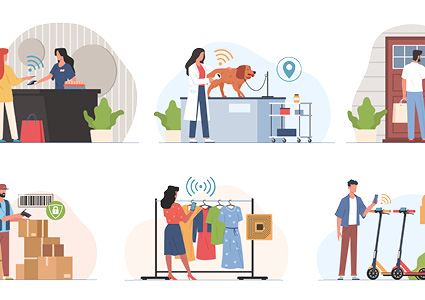
That combination brings physical and digital closer together, with both environments informed by timely, actionable data. Stores begin to operate with the same level of intelligence as e-commerce, but with the added advantage of physical experience and immediacy.
What should retailers prioritize when deploying wireless power networks to enable Ambient IoT solutions?
The starting point is focus. Rather than trying to instrument everything all at once, retailers are seeing the most success by targeting specific use cases where visibility gaps are already impacting performance – whether that be shelf availability, replenishment, or inventory accuracy.
From there, it’s about embedding the data into how the store already operates. The value comes when in-sights are connected to action, feeding into replenishment decisions, merchandising adjustments, and day-to-day execution.
Infrastructure still matters, particularly when it comes to scale. Technologies like wireless power make it
possible to support large volumes of connected items without introducing ongoing maintenance, which is critical as deployments expand.
Adoption ultimately comes down to establishing a system that reflects how the store is operating on an ongoing basis. With that foundation in place, retailers can expand into new use cases, layer in automation, and build toward a more connected, data-driven retail environment over time.
Giampaolo Marino
Giampaolo Marino is Chief Strategy and Growth Officer at Energous. Energous Wireless Power Solutions next-generation wireless power networks enable unprecedented levels of visibility, control, and intelligent business automation. Its scalable, RF-based wireless power network (WPN) solutions connect businesses with critical data transmission, delivering operational efficiency with fewer batteries for a smarter, more sustainable future.