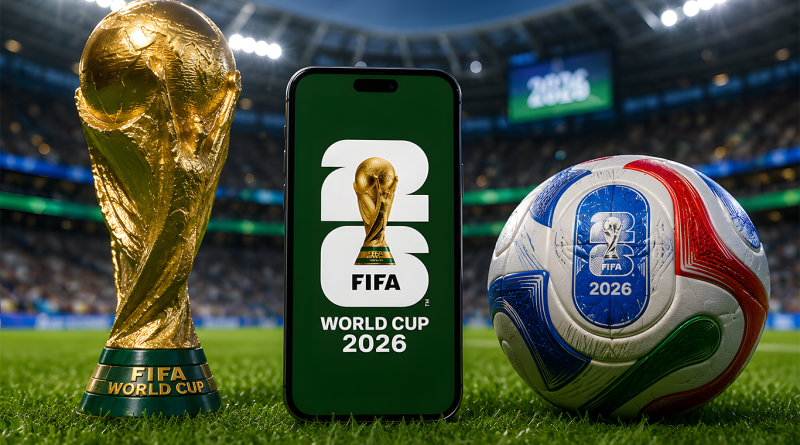
The 2026 World Cup is rewriting the rules of sports marketing
Subscribe to our free newsletter today to keep up to date with the latest retail news.
The 2026 FIFA World Cup has become more than the world’s biggest sporting event. It has evolved into one of the most significant marketing battlegrounds of the decade, where the value of sponsorship is increasingly measured not by logo visibility but by cultural relevance.
For retailers, food brands and consumer goods companies, the tournament has offered a live demonstration of how audiences now consume major sporting events. Fans are no longer simply watching 90 minutes of football. They are scrolling social media, creating memes, sharing clips, reacting to controversy and joining conversations that often move faster than the action on the pitch.
The brands that have recognised this shift have generated meaningful engagement. Those relying on traditional sponsorship rights have often found themselves overshadowed by more agile competitors or, in some cases, caught up in debates about the commercialisation of the tournament itself.
Perhaps no issue has illustrated that divide more clearly than FIFA’s controversial hydration breaks.
When visibility becomes a liability
Introduced as a player welfare measure in response to concerns over extreme summer temperatures across North America, mandatory hydration breaks have quickly become one of the defining talking points of the tournament.
While player safety remains the official justification, many supporters, particularly in Europe and South America, have viewed the three minute stoppages with scepticism. The breaks have created additional commercial inventory for broadcasters, leading many fans to question whether player welfare and advertising opportunities have become intertwined.
For Gatorade, whose branding dominates these intervals, the result has been unusually complex.
The PepsiCo-owned sports drink has achieved one of the highest levels of brand visibility anywhere in the competition. Every hydration break reinforces its position as a performance brand closely associated with elite athletes and professional sport.
Yet visibility alone does not guarantee positive brand perception.
On social media, hydration breaks have frequently become flashpoints for criticism of football’s growing commercialisation. Clips of supporters booing the stoppages have circulated widely, with conversations often focusing less on player welfare than on the additional advertising opportunities they create.
The challenge for Gatorade is that while it effectively owns these moments from a sponsorship perspective, it has relatively little influence over how audiences interpret them. Instead of reinforcing its performance credentials, the brand has found itself associated with one of the tournament’s most divisive innovations.
It serves as a reminder that sponsorship assets no longer exist in isolation. Every activation is immediately scrutinised, debated and reframed through millions of online conversations.
That reality presents both opportunity and risk for marketers.
Other brands have demonstrated that participation in those conversations can prove far more valuable than dominating broadcast coverage.
Coca-Cola has largely avoided controversy by remaining focused on emotional storytelling rather than aggressive visibility. Its campaigns have centred on celebrations, family viewing occasions and local fan experiences across host cities, reinforcing long established associations with shared moments rather than attempting to control the conversation.
McDonald’s has followed a similarly integrated strategy. Instead of relying primarily on stadium signage, the company has woven the tournament into its digital ecosystem through loyalty rewards, limited-time menu offers and grassroots football initiatives. The campaign extends beyond the stadium and creates repeated consumer touchpoints throughout the competition.
These approaches reflect a broader shift in sports marketing. Increasingly, successful campaigns are those that become part of the fan experience rather than interrupting it.
Authenticity beats official status
Official sponsorship continues to matter, but only when it supports genuine relevance.
Adidas has arguably emerged as one of the tournament’s strongest commercial performers because its presence feels entirely natural. As supplier of the official match ball, referee kits and numerous national teams, the brand remains visible throughout almost every match without needing to manufacture attention.
Every goal, every replay and every trophy presentation reinforces Adidas’ connection to elite football.
Nike has enjoyed considerable exposure through stars including Kylian Mbappé, Vinícius Júnior and members of the England squad. Individual athletes continue to generate enormous engagement across digital platforms, but athlete partnerships inevitably fluctuate with results and performances.
Tournament-wide integration offers a more consistent presence, allowing Adidas to remain central to the competition regardless of which teams progress.
The distinction highlights an increasingly important principle for marketers.
Fans are becoming highly adept at distinguishing between brands that genuinely belong within sporting culture and those seeking to capitalise on it. Authenticity is increasingly earned through long-term participation rather than short-term campaigns.
Lay’s has benefited from understanding another fundamental aspect of modern football consumption.
Most supporters never enter a stadium.
They experience the World Cup from living rooms, pubs, restaurants and family gatherings. Rather than focusing exclusively on the spectacle inside the stadium, Lay’s has positioned itself around watch parties and shared viewing occasions, directly aligning the brand with retail purchasing behaviour.
The strategy reflects an appreciation of where commercial decisions are actually made. Consumers buying snacks for a viewing party represent an immediate sales opportunity that extends well beyond traditional sponsorship exposure.
Meanwhile, Burger King has continued to demonstrate the value of reactive marketing.
Its social media teams have responded rapidly to unexpected match moments, player celebrations and controversial incidents, producing content within minutes while conversations remain at their peak.
This speed has become a competitive advantage in itself.
Global sporting events now generate millions of real-time interactions across social platforms. Campaigns planned months in advance can quickly appear disconnected if they fail to respond to unfolding events.
Marketing agencies increasingly argue that flexibility now delivers stronger engagement than polished creative that cannot adapt once a tournament begins.
Marketing success is becoming harder to buy
The biggest lesson from the 2026 World Cup may be that traditional sponsorship models are becoming less predictable.
For decades, brands measured success through television audiences, stadium signage and estimated media value. Those metrics remain important, but they no longer tell the full story.
Consumers actively shape brand narratives through social media, often giving equal weight to memes, fan reactions and influencer commentary as official advertising.
That makes sponsorship considerably more complex.
Owning premium advertising inventory no longer guarantees favourable perception if the surrounding conversation turns negative. Likewise, brands without official rights can generate enormous engagement through creativity, authenticity and speed.
Retailers have experienced similar contrasts.
Sports retailers have benefited from sustained demand for replica shirts and official merchandise, particularly as fans celebrate surprise performances and emerging stars. Fashion brands launching football-inspired collections have enjoyed far less success, with consumers appearing increasingly selective about which companies possess genuine sporting credibility.
The tournament demonstrates that modern sports marketing is no longer simply about being seen.
It is about becoming part of the culture surrounding the event.
As the World Cup reaches its closing stages, the campaigns likely to be remembered will not necessarily belong to the companies with the largest sponsorship budgets. Instead, they will be those that understood how supporters now experience football through conversation as much as competition.
For marketers, that represents both a challenge and an opportunity. Visibility remains valuable, but relevance increasingly determines whether that visibility translates into positive brand equity. In an environment where every campaign is dissected in real time, authenticity, speed and emotional connection have become stronger assets than advertising inventory alone.
The brands lifting the commercial trophy this summer are not simply sponsoring football. They are participating in the stories that fans choose to tell.
Source: